THY-Twin: A Digital Navigation and Auditing Twin for Ultrasound-Guided Thyroid Ablation

1Nanjing University 2The Central Hospital of Wuhan, Tongji Medical College, Huazhong University of Science and Technology 3Zhongshan Hospital, Fudan University

Abstract

Thyroid thermal ablation is increasingly used as a minimally invasive alternative to surgery, yet routine clinical practice still depends on conventional two-dimensional (2D) ultrasound and operator experience, limiting objective margin control and function-preserving decisions. Leveraging advances in digital health, we develop THY-Twin, a patient-specific digital-twin framework for self-supervised artificial intelligence (AI)-guided ablation. THY-Twin provides continuous, quantitative, and auditable three-dimensional (3D) guidance across preoperative planning, intraoperative navigation, and postoperative assessment directly from standard 2D ultrasound. In a multicenter real-world cohort, THY-Twin-assisted workflows outperform standard-of-care clinical workflows, reducing preoperative planning time by more than 50%, shortening intraoperative time-to-target by about 50%, and significantly improving ablation coverage accuracy. The framework also computes a novel volumetric metric, the expansion ratio, offering a reproducible, geometry-aware measure of treatment adequacy unavailable in conventional assessment. By transforming fragmented 2D cues into intuitive 3D navigation and auditable spatial feedback, THY-Twin helps reduce cognitive burden, improve cross-center consistency, and support safer routine decisions. Its lightweight, hardware-free design enables scalable deployment, even in resource-limited settings.

Overview of THY-Twin
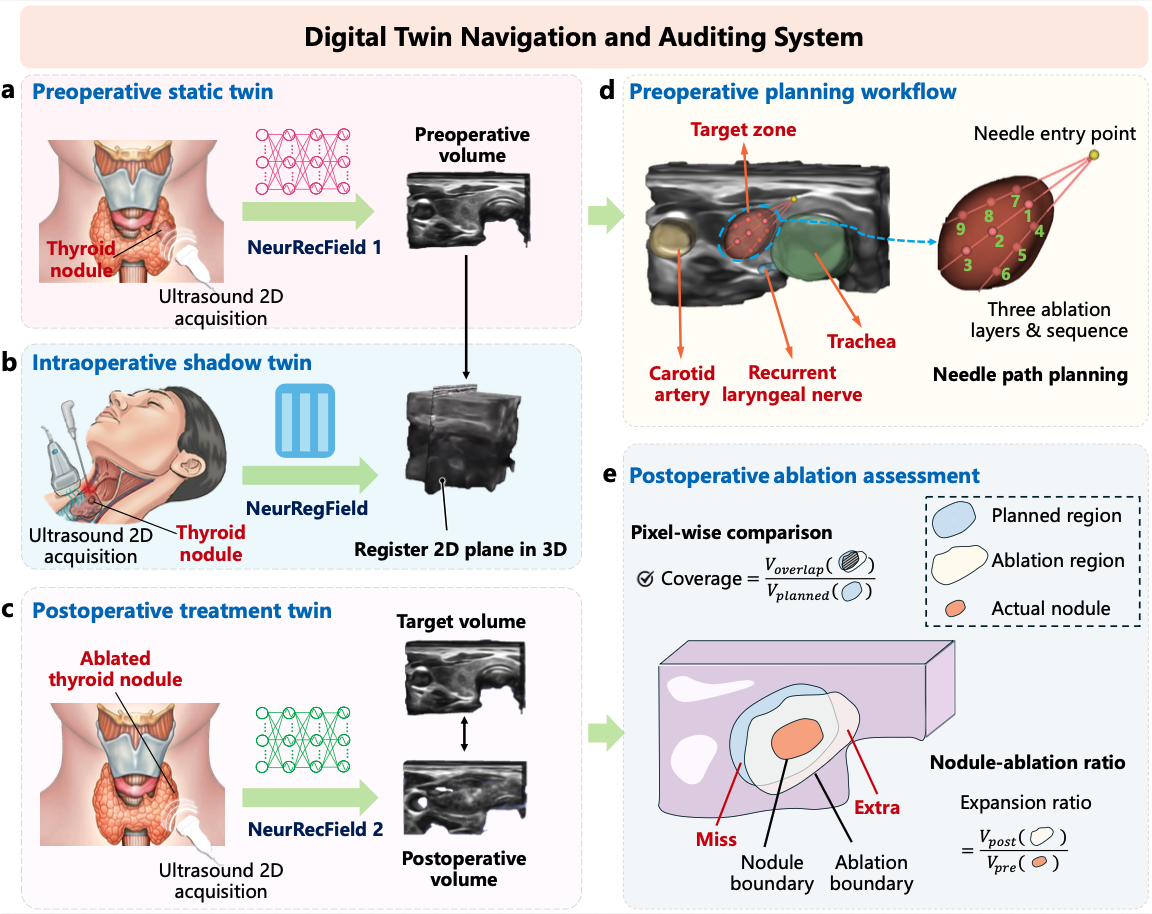
Digital Twin Navigation and Auditing System
Digital Twin Navigation and Auditing System. (a) Preoperative Static Twin: a short preoperative ultrasound sweep is used to reconstruct a patient-specific 3D thyroid model for individualized planning. (b) Intraoperative Shadow Twin: real-time 2D ultrasound frames are continuously aligned with the preoperative 3D twin to maintain spatial correspondence during needle guidance. (c) Postoperative Treatment Twin: post-ablation ultrasound data are reconstructed and co-registered with the preoperative model to quantify ablation coverage and treatment completeness. (d) Preoperative planning: the reconstructed 3D thyroid volume is first generated from a brief 2D sector sweep. Following this, the target ablation zone is defined and critical risk structures (such as carotid artery, recurrent laryngeal nerve and trachea) are annotated, culminating in needle path planning. (e) Postoperative ablation assessment: THY-Twin computes treatment coverage and introduces a new volumetric metric, the expansion ratio enabling objective evaluation of ablation adequacy and post-treatment geometric expansion. NeurRecField: Neural Reconstruction Field, NeurRegField: Neural Registration Field.

BibTeX

@article{shen2026thy-twin,
  author = {Shen, Chengkang and Zhou, You and Zhu, Hao and Wang, Longqiang and Zhang, XueJing and Cao, Xun and Jiang, Ming and Jin, Yunjie and Lin, Yi and Ma, Zhan},
  title = {THY-Twin: A Digital Navigation and Auditing Twin for Ultrasound-Guided Thyroid Ablation},
  journal = {},
  year = {2026},
}